Haris RehmanAlberta, Canada

AI Product Manager · ML Researcher

Turning founder chaos into shippable AI products.

A Solutions Architect's brain and an engineer's hands. 200K to 1.2M users at ChatlyAI, computer vision for a patented fibre-optic robot on a factory floor in Illinois, and multimodal clinical ML at the University of Alberta.

Selected work

3 case studies

An AI chat product with good retention and a user graph that kept flattening. Restructuring how conversations persisted was the unlock.

Role
Associate Product Manager
Timeline
Oct 2025 — Jun 2026
Team
5 → 35+ cross-functional
Monthly active users
6x
D30 retention
2.3x
Session length
+40%
Revenue contribution
$6.5M+

Problem

ChatlyAI had decent retention for an AI chat product but inconsistent growth — the kind of user graph that goes up and then flattens. Up and flattens. The product worked. Users who stuck around loved it. The problem was getting people to stick around.

Constraint

A narrow high-growth window and no time to buy the answer. SEO content took 60 days to show results, which was too slow for the moment we were in.

Decision

I went after the activation moment rather than the top of the funnel. Users who joined an active thread within their first 10 minutes had dramatically higher 30-day retention, so we made threads persist — conversations that grew and built context over time, instead of every session being ephemeral. We shipped it without announcing it, because the bet was that users would discover it and not want to leave.

Outcome

200K to 1.2M+ monthly actives in under a year. D30 retention improved 2.3x over eight months, session length rose 40%, and the work contributed to $6.5M+ in revenue.
viaPhoton’s patented fiber organizer, on a factory floor in Aurora, Illinois. Machine learning and computer vision took fiber sorting from three minutes to eight seconds per cable, inside an automation effort that lifted capacity forty times.

Role
Machine Learning Engineer, Cowlar Design Studio
Timeline
Oct — Dec 2024
Capacity increase
40x
Sorting accuracy
96%
Alignment precision
5µm
Cables per month
9,600

Problem

An Amazon-partnered fiber optics supplier in Aurora, Illinois was building about 240 cables a month. Before a cable can be terminated, its 250-micron fibers have to be in the right order and precisely aligned, and sorting the fibers for one cable took about three minutes.

Constraint

Each fiber is a quarter of a millimetre across and alignment had to hold to 5 micrometres — on a production line run by operators rather than data scientists, where every second of latency is paid on every cable.

Decision

I treated the model as the small part of the problem — maybe 30% of the work. The rest was everything around it: image capture that behaves the same on every shift, inference that fits the machine’s timing, and the edge cases a clean dataset never contains. A 96% model an operator cannot run is worth less than a 90% model they can.

Outcome

Fiber sorting fell from about three minutes to eight seconds per cable at 96% accuracy, with alignment held to 5 micrometres. On the organizer line, AWS cable output went from one an hour to six; across the wider factory automation, monthly capacity went from 240 cables to 9,600 — 40x. The machine is covered by viaPhoton’s US Patent 12,001,073 B2.

Video action recognition running on a Raspberry Pi bolted to a supermarket trolley, where the enemy was never accuracy. It was latency.

Role
Machine Learning Engineer
Timeline
2024
Real-time accuracy
95%
End-to-end inference
<80ms
Action classes
6
Live deployment
Qatar

Problem

Smart carts need to understand what shoppers are doing in real time — picking up items, placing them back, weighing produce — and they have to do it in a live supermarket, not a lab.

Constraint

The hardest part was never accuracy. It was latency, on constrained hardware. Any delay between a shopper picking up an item and seeing it appear on the display destroys the experience, and the compute was a Raspberry Pi module inside the cart.

Decision

I chose MoViNet — a mobile video network built specifically for temporal understanding on edge devices — over a heavier, more accurate backbone, and then bought the accuracy back through data rather than parameters: 8,000+ action clips collected in-store rather than pulled from a public dataset.

Outcome

95% real-time accuracy across six action classes at sub-80ms end-to-end inference. Deployed and operational at Al-Meera Supermarkets in Qatar, with real shoppers.

Also built

Shipped, not written up

About

Alberta, Canada
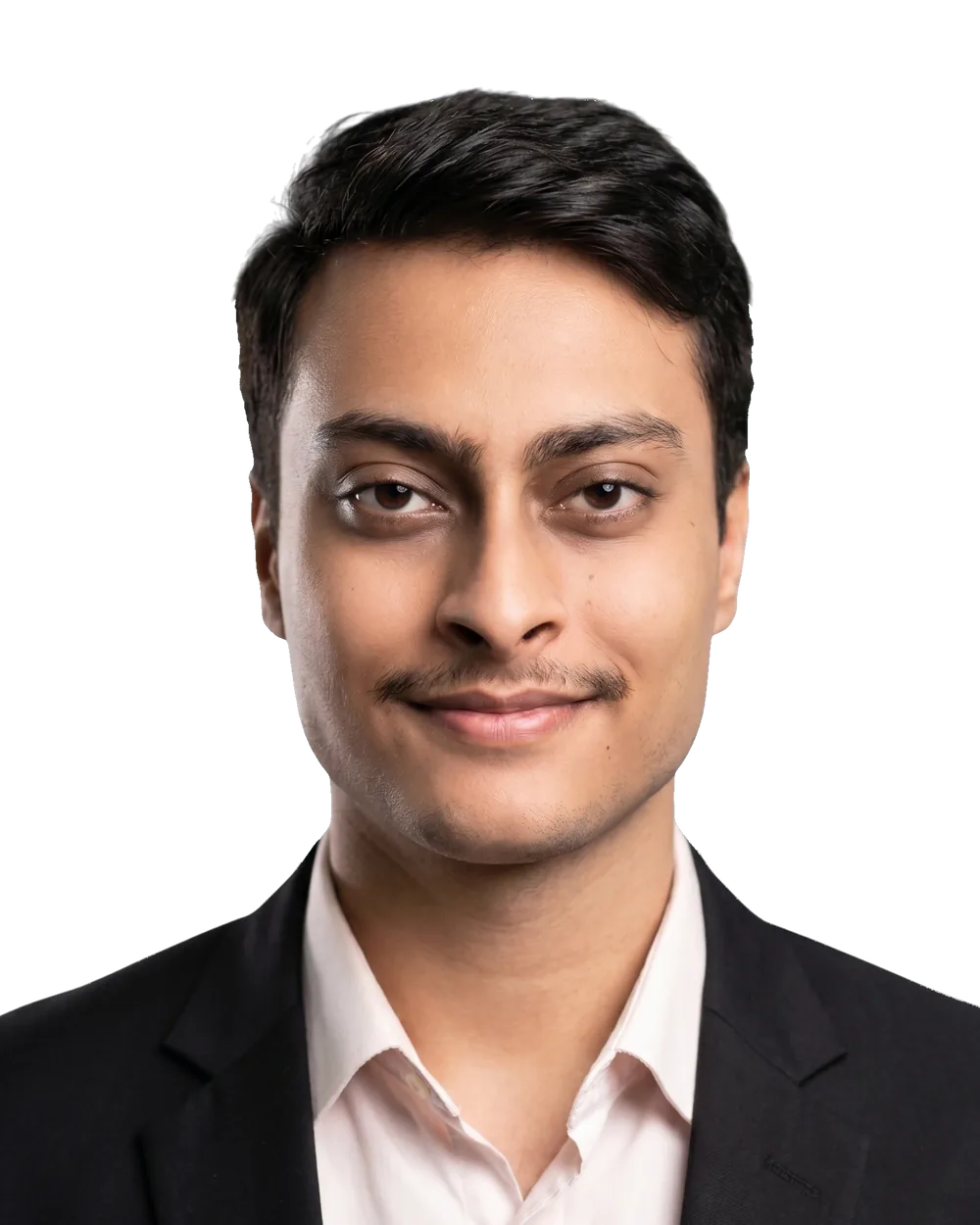
Haris Rehman, head and shoulders, in a dark jacket over an open pale shirt, looking directly at the camera.

The engineer who crossed over, and then crossed back.

I used to spend my weekends debugging segmentation faults in C++ that ran on factory floors in Illinois. The robot I worked on sorted optical fibre a quarter of a millimetre wide, aligned to five microns. That is the kind of work that teaches you what precision means.

Nobody tells you, when you are deep in that world, that the hardest problems are not technical. The code was fine. The models were fine. What was not fine was the meeting where nobody could agree on what to build next, or the founder with fourteen ideas and no north star.

So I went and did that job instead. Two years later I had taken an AI chat product from 200,000 users to 1.2 million, and learned that debugging a roadmap uses most of the same muscles as debugging a binary — you are still isolating a variable and asking what changed.

I am now at the University of Alberta doing machine learning research on multimodal clinical prediction: ECG waveforms, clinical notes and EHR event streams, and how much genuinely new signal you get by combining them. The honest answer, sometimes, is less than you hoped — which is the part of research I find most worth publishing.

Education
B.Sc. Software Engineering, National University of Science and Technology (NUST)
Based in
Alberta, Canada
  • Cambridge Outstanding Learner — ranked 2nd in Punjab across 5 A-Level subjects.
  • NSTC — top 50 nationally in Mathematics, selected to compete for a place on the International Math Olympiad team.
  • Ultralytics YOLO contributor — distributed parallel training.

Experience

2023 — present
  • University of Alberta

    Artificial Intelligence Researcher

    Alberta, Canada · On-site

    Jun 2026 Present

    • Conducting machine learning research in multimodal clinical prediction, combining 12-lead ECG waveforms, clinical notes, and structured EHR event streams across multiple hospital episodes from MIMIC-IV.
    • Built an end-to-end benchmark for ECG and clinical-text fusion, enabling controlled patient-level comparisons across ECG-only, text-only, and multimodal models for AF outcomes, heart failure, cardiovascular diagnosis, and long-term prognosis.
    • Developed and evaluated 8 multimodal fusion architectures and multiple ECG/text encoders, with patient-level bootstrap confidence intervals, DeLong testing, leakage audits, and reproducible experiment pipelines.
    • Demonstrated that combining ECG and clinical text substantially improves cardiovascular outcome prediction, while identifying information ceilings for rare stroke and bleeding outcomes rather than overstating model performance.
    • Used MetaboNet, a 14-dataset, 16M+ window benchmark for Type-1 Diabetes glucose forecasting, integrating CGM, insulin, carbohydrate, activity, and patient-level information into a unified evaluation framework.
    • Contributed to MetaboNet, an international competition and benchmark for multimodal glucose forecasting, developing and evaluating temporal architectures including Mamba-2, PatchTST, TFT, TiDE, and TCN across multiple forecasting horizons.
    • Emphasised reproducible and statistically rigorous ML research through automated testing, patient-disjoint evaluation, bootstrap comparisons, seed-noise analysis, leakage detection, and large-scale multi-GPU experimentation.
  • ImagineArt (ChatlyAI)

    Associate Product Manager

    Islamabad, Pakistan · On-site

    Oct 2025 Jun 2026

  • Cowlar Design StudioYC W-17

    Machine Learning Engineer

    Islamabad, Pakistan · Hybrid

    Apr 2024 Apr 2025

  • Upwork & Fiverr

    Machine Learning Engineer

    Remote · Freelance

    Aug 2023 Apr 2024

  • CodSoft

    Machine Learning Engineer Intern

    Remote · Internship

    Aug 2023 Sep 2023

Credentials

B.Sc. Software Engineering

Contact

Open to conversations

Tell me what is not working.

Research collaborations, product problems that have gone circular, or an ML system that works in a notebook and nowhere else. I read everything that arrives.